American folklore creatures are everywhere once you start looking. Most people know the big names — Bigfoot, the Jersey Devil, the Mothman. Those have documentaries now. T-shirts. Tourism.
But beneath those famous few is a much stranger layer of American horror creatures that never made it to mainstream culture. Regional monsters, communities pass down in specific towns and communities, tied to local geography and local fear. The kind of thing your grandmother’s neighbor might have mentioned once and never brought up again.
These are some of the ones worth knowing.
The Wampus Cat of Appalachia – American Folklore Creatures of Appalachia
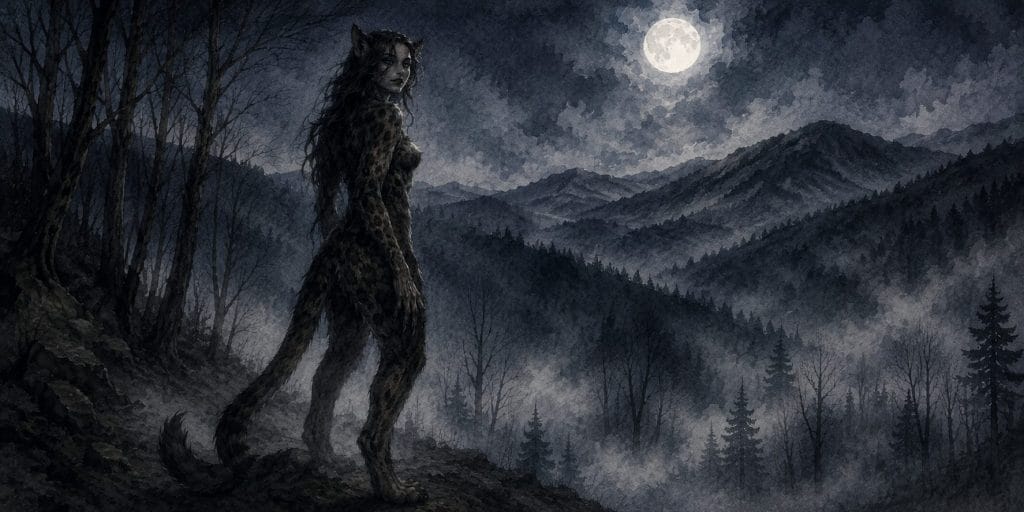
The Wampus Cat shows up across Appalachian folklore, particularly in Tennessee, Virginia, and the Carolinas. Descriptions vary — sometimes it’s a large mountain cat that walks upright. Sometimes it’s half woman and half feline. And sometimes it’s simply a creature whose scream sounds too human to ignore.
Indeed, the origin story that surfaces most often involves a Cherokee woman who disguised herself in an animal hide to spy on a sacred ceremony she was forbidden to witness. As punishment, she was transformed into the creature she was wearing. Consequently, she exists at the edge of the forest forever — neither woman nor animal, belonging to neither world.
Specifically, the Wampus Cat’s scream is the part that people remember. Witnesses consistently describe it as something that sounds like a woman in distress. You hear it and you move toward it. That instinct, in the dark of the Appalachian mountains, is exactly what the creature relies on.
The Hidebehind of the Logging Camps
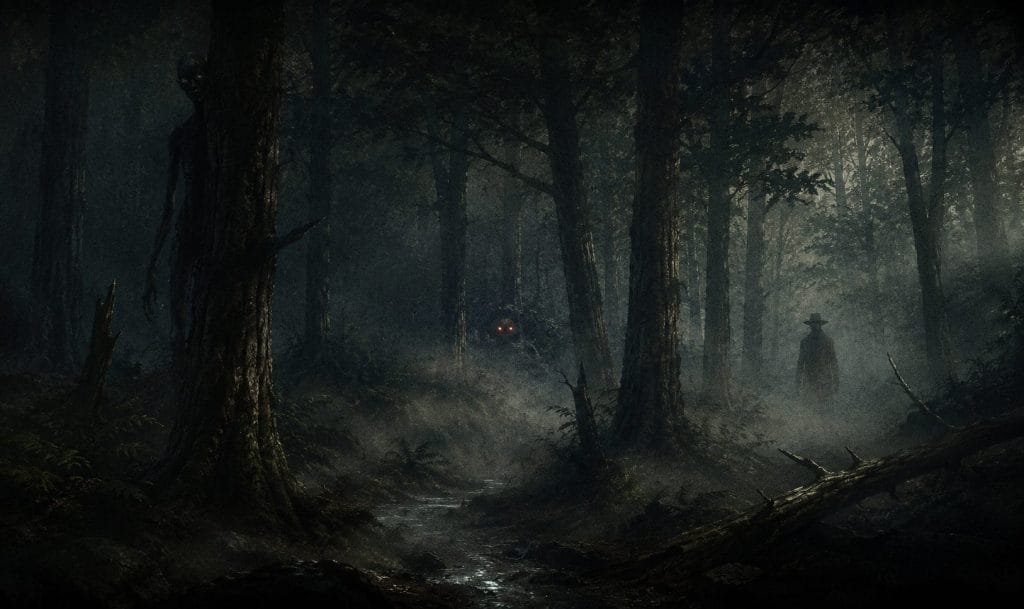
Ultimately, the Hidebehind comes from 19th-century logging American folklore creatures, spread through the camps of the American Northwest. It’s a tall, thin creature — always thin, thin enough to conceal itself completely behind a tree trunk no matter the angle you approach from.
You cannot see it directly. Furthermore, every time you turn to look, it has already moved. It is always behind you, always just out of your peripheral vision, always between you and the way back to camp.
Loggers who disappeared alone in the forest loggers blamed on the Hidebehind. The creature was said to prey specifically on people who wandered away from the group. This made it a convenient explanation for disappearances. And also a useful warning: stay together, stay on the path, don’t go into the trees alone.
What makes the Hidebehind genuinely unsettling as a piece of American folklore creatures is the mechanism. It’s not fast or powerful or supernatural in an obvious way. They simply cannot be seen. You can never confirm it’s not there. That uncertainty is the whole point.
The Snallygaster of Maryland – American folklore creatures
The Snallygaster was first reported in the South Mountain region of Maryland in the early 1900s. It’s described as a half-reptile, half-bird creature with a metallic beak, tentacles, and one enormous eye in the center of its forehead. It swooped down on livestock and occasionally on people, carrying them off into the sky.
Notably, what’s interesting about the Snallygaster is that the Smithsonian Institution reportedly took the reports seriously enough to send investigators. President Theodore Roosevelt allegedly considered postponing a safari to hunt it. Whether any of that is true is another question, but it suggests how seriously the creature entered public consciousness.
The Snallygaster eventually faded from reports, but it left behind a regional identity. People in Frederick County, Maryland still reference it. There’s a beer named after it. In contrast to creatures that stay frightening, the Snallygaster became something like a local mascot — which is its own kind of strange afterlife for a monster.
The Rougarou of Louisiana
The Rougarou is Louisiana Cajun folklore’s version of the werewolf, but it operates differently from the European tradition. It doesn’t require a full moon. It doesn’t require a bite. Instead, it finds people who have broken Lent — specifically Catholics who failed to observe the 40 days properly for seven years running.
It has the body of a man and the head of a wolf or dog, and it roams the swamps and bayous at night. Notably, if you see it and tell anyone within a year and a day, the curse transfers to you.
That detail is worth sitting with. The Rougarou is a creature that survives partly because talking about it is dangerous. It carries its own silencing mechanism, which means actual witnesses — if such a thing were real — would have good reason to stay quiet. The folklore is self-protecting in a way that feels almost deliberately designed.
The Ozark Howler
The Ozark Howler people report across Arkansas, Missouri, Oklahoma, and Texas — a large black cat with thick fur, glowing red eyes. A howl described variously as a combination of a wolf’s howl and an elk’s bugle. It moves through the Ozark mountains and appears most often to people traveling alone at night.
Meanwhile Cryptozoologists argue about whether it’s a surviving population of some large cat species or something else entirely. The American folklore creatures community treats it as something older. A creature tied to the land itself, appearing as a warning or an omen rather than simply as a predator.
Moreover, what distinguishes the Ozark Howler from similar regional creatures is the sound. Multiple accounts across different states and different decades describe the same distinctive call. something that shouldn’t exist, that doesn’t match any known animal, that stops people in place when they hear it. Sound is harder to misidentify than a shape in the dark. Meanwhile, that consistency makes the Ozark Howler one of the more persistent pieces of American folklore that hasn’t been explained away.
What These American Folklore Creatures Have in Common
None of these monsters are simple. They don’t just chase you. They exploit something — an instinct to move toward a human scream. Also an inability to confirm what’s behind you, a religious guilt that makes you vulnerable. The isolation of being alone in unfamiliar terrain.
Furthermore, the most durable pieces of American folklore work the same way the best horror fiction does. They find the gap between what you know and what you can verify, and they live in that gap. It doesn’t need to be real to be effective. They just need to be possible.
That ambiguity — the monster that might be there, the threat you cannot directly observe. The entity that understands your weaknesses better than you do. This is exactly what writers reach for when they want to create something genuinely frightening.
The EggsTabletMan and the American Folklore creatures Tradition
Mystro H. Minnor’s debut novel The EggsTabletMan sits squarely in this tradition. The EggsTabletMan himself is a folkloric creature in the truest sense — his origins are disputed within the novel. His nature is never fully explained, and different communities understand him differently. The children of Little Ashland know him through a rhyme passed down in whispers. Adults don’t see him at all.
Also, he finds the lonely and the gifted, the people standing at the edges of their own lives, and he offers them exactly what they need. Like the Rougarou’s silencing curse, like the Hidebehind’s invisibility, his power is structural. It’s not what he does to you. It’s how he’s designed so that you can’t quite resist him.
The EggsTabletMan is available now on Amazon, Barnes & Noble, and Walmart. Read the first three chapters free at eggstabletman.com.